
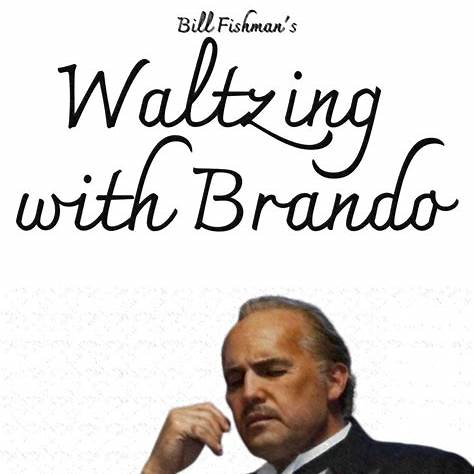
Based on Bernard Judge’s 2011 memoir of the same name, Waltzing with Brando feels like a half-forgotten story brought to vivid life. Judge, a Los Angeles–based architect, suddenly finds himself invited to Tahiti by Marlon Brando to help design a sustainable paradise on a remote island. What begins as a professional assignment becomes a tale of unlikely partnership, clashing visions, and a dream teetering between fantasy and folly. On screen, it is part character study, part revelation, and part cautionary tale about the collision of ego, artistry, and ambition.
The film wastes no time plunging us into Judge’s dilemma. Brando doesn’t merely want a home; he wants an entire model for eco-living decades before sustainability became a cultural buzzword. For Judge, the offer is both thrilling and terrifying. How do you satisfy a man who reshaped cinema while confronting the unforgiving realities of geography, climate, logistics, and sheer willpower? That question forms the core tension of the narrative. The stakes are never about blueprints alone, but about how much of one’s professional integrity can be bent—or preserved—under the weight of celebrity.
The performances drive the film’s success. Billy Zane delivers what may be his career-defining role as Brando. He doesn’t mimic or parody the legend; he inhabits him. From the playful cadence of his speech to the sudden shifts into brooding silences, Zane channels a Brando who is both domineering and oddly fragile. His portrayal avoids caricature and instead suggests a man burdened by his own myth. A significant share of the credit belongs to the makeup team, whose work is seamless. Zane’s resemblance to the enigmatic actor is startling, a piece of invisible artistry that underpins the illusion. Without their contribution, his performance would not have been so persuasive. It is not hyperbole to say their work deserves to be part of the awards conversation.
Yet this is not Brando’s story alone. Bernard Judge, played with quiet persistence by Jon Heder, anchors the film. Heder’s Bernard is the counterweight to Zane’s mercurial Brando, a man who wants only to apply his training honestly in the face of demands that border on the impossible. Through Bernard’s eyes, the audience experiences the absurdity, the frustration, and the moments of wonder that defined this improbable collaboration. His perspective keeps the film grounded. Brando may be the gravitational pull, but Bernard is the human center.
What makes the film resonate is its relatability. Few of us can identify with Brando, a larger-than-life Oscar winner whose legacy is etched into cinematic history. But many of us can identify with Bernard: a professional, skilled in his craft, suddenly facing unreasonable expectations and struggling to reconcile ambition with principle. It is his struggle—not Brando’s legend—that gives the story its true emotional weight.
Both leads are worthy of awards consideration. Heder’s understated performance gives the film its heartbeat. His restraint, his unshowy persistence, makes Bernard’s story credible. Zane deserves equal recognition as Supporting Actor, not only for the uncanny likeness but also for capturing Brando’s contradictions: playful one moment, manipulative the next, and occasionally disarmingly vulnerable. Together, they elevate the film, smoothing over its uneven stretches and giving it a vitality that lingers.
Those uneven stretches are real. The film occasionally loses focus in sequences that feel ornamental, pretty diversions that do little to drive the story forward. Most jarring is one scene in which Bernard behaves in a way that betrays the morality and integrity the script has so carefully built for him. It feels contrived, inserted more to provoke than to illuminate. When a character has been drawn with such deliberate care, a sudden lapse rings false. The film recovers, thanks to Heder’s steadiness and Zane’s magnetism, but the stumble remains noticeable.
Visually, the Tahitian setting becomes almost a character itself. The island mirrors the isolation Brando seems to crave. The natural beauty contrasts sharply with the practical and ethical challenges Bernard faces, making paradise feel both alluring and suffocating. The cinematography invites viewers to marvel at the landscape even as the story suggests how difficult it would have been to tame and reshape it.
What elevates the film beyond a two-man character piece is its revelation of a little-known chapter in Brando’s life. Long before environmental consciousness became mainstream, he dreamed of creating a sustainable retreat in Tahiti. That ambition, mostly forgotten, reframes Brando as more than just a cinematic legend. He emerges as a man with visions—grand, quixotic—yet still remarkable in their prescience. The film makes us reconsider what kind of legacy truly matters: the roles an actor played on screen, or the dreams he pursued when the cameras stopped rolling.
Waltzing with Brando is imperfect. Its pacing wavers, and its storytelling sometimes slips into clumsy choices. But its performances are exceptional, its setting mesmerizing, and its story surprisingly affecting. By giving equal weight to Judge’s professional struggle and Brando’s eccentric ambition, the film transcends biography and becomes a meditation on collaboration, integrity, and the limits of genius. It reminds us that legends are not only shaped by their triumphs but also by the dreams they chased, even when those dreams seemed impossible.
For all its flaws, the film lingers. Thanks to Heder’s quiet strength and Zane’s startling transformation, Waltzing with Brando achieves something rare: it pulls back the curtain on myth while still honoring the messy, human desires that drive even the most celebrated lives. That makes it not just a curiosity, but a film well worth watching.