
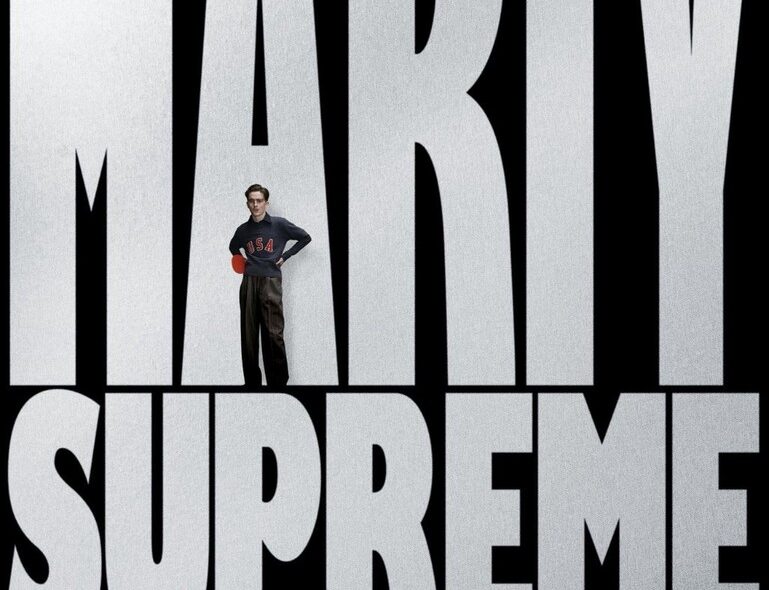
With Marty Supreme, Timothée Chalamet dives headfirst into one of the most eccentric and physically charged roles of his career, teaming with filmmaker Josh Safdie for a movie that treats ambition as a contact sport. Set in the kinetic churn of 1950s New York City, the film tracks Marty Mauser, a ferociously self-confident table-tennis prodigy who believes, with almost manic certainty, that greatness is his birthright—even if the rest of the world barely notices his chosen arena.
Inspired by the outsized personality of real-life ping-pong legend Marty Reisman, Marty Supreme is less a traditional sports biopic than a character study fueled by swagger, hustle, and emotional volatility. Marty isn’t just trying to win matches; he’s trying to impose his will on everyone around him, from back-room gamblers to international competitors. Safdie shoots the game itself with the intensity of a street fight, turning paddles, sweat, and rapid-fire rallies into a kind of cinematic percussion that mirrors Marty’s inner chaos.
Chalamet’s performance is the film’s centrifugal force. He plays Marty as charming, abrasive, seductive, and exhausting—sometimes all within the same scene. It’s a portrayal built on restless motion and sharp edges, one that asks the audience not to like Marty so much as to be unable to look away from him. The role leans hard into physicality, with Chalamet performing demanding table-tennis sequences himself, and into psychological bravado, revealing a man whose bravura barely masks a gnawing fear of being ordinary.
The supporting cast adds texture and unpredictability. Gwyneth Paltrow appears as Kay Stone, a woman navigating her own fading stardom while circling Marty’s rising one. Odessa A’zion brings volatility and vulnerability as Rachel, whose relationship with Marty oscillates between inspiration and implosion. Kevin O’Leary shows up as Milton Rockwell, a financier whose transactional worldview clashes with Marty’s messianic self-belief, while Tyler, the Creator, Fran Drescher, and Abel Ferrara populate the film’s margins with the kind of offbeat authenticity Safdie favors.
Premiering to electric reactions on the festival circuit, Marty Supreme quickly developed a reputation as one of the year’s most bracing and divisive films. Admirers praise its refusal to smooth out its protagonist’s roughest qualities and its commitment to depicting ambition as something messy, compulsive, and sometimes ugly. Detractors find its energy overwhelming. That split, however, has only fueled the film’s momentum, positioning it as a conversation piece rather than a prestige artifact.
Commercially, the film has exceeded early expectations. After a blistering limited release marked by standout per-theater averages, Marty Supreme expanded nationwide with strong word-of-mouth, especially among younger audiences and awards-season voters. For its distributor, A24, the movie is shaping up as one of its most successful releases, proof that a boldly idiosyncratic character study can still break through in a crowded marketplace.
Awards buzz has followed closely behind. Chalamet is widely cited as a major contender in the Best Actor race, with many viewing the role as a pivot point—less ethereal than his earlier work, more abrasive and risk-embracing. The film itself has entered discussions for nominations in acting, screenplay, and picture categories, buoyed by Safdie’s muscular direction and Chalamet’s all-in commitment.
Marty Supreme doesn’t aim for universal appeal. Instead, it plays like its protagonist—loud, relentless, and unapologetically convinced of its own importance. In doing so, it gives Chalamet a showcase that feels dangerous in the best way, a performance that risks alienation in pursuit of something rawer and more enduring. Whether it sweeps awards or simply polarizes audiences, the film has already done what Marty Mauser would respect most: it’s made itself impossible to ignore.