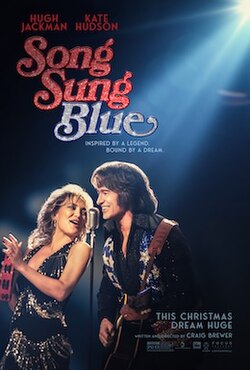
There’s a certain inevitability to Song Sung Blue, a warm, unabashedly romantic musical built around the enduring catalog of Neil Diamond. The film stars Hugh Jackman opposite Kate Hudson in a story that leans into sentiment, resilience, and the belief that music can stitch together lives that seem to be coming apart at the seams.
Inspired by a real-life couple whose shared love of Neil Diamond songs helped them weather personal and financial setbacks, Song Sung Blue follows Mike and Claire, two working-class strangers who meet by chance and discover a mutual devotion to Diamond’s music. What begins as a casual bond over familiar lyrics evolves into a partnership, both romantic and creative, as they decide to form a Neil Diamond tribute act. Neither is chasing fame so much as stability, connection, and a sense of purpose they’ve both lost somewhere along the way.
Jackman plays Mike with an earnest, slightly weathered charm, portraying a man who has taken enough hits from life to be wary of hope but not quite ready to give up on it. Hudson’s Claire is more openly vulnerable, her optimism bruised but intact, and the chemistry between them is the film’s emotional engine. Their performances aren’t about virtuoso vocal showmanship as much as emotional accessibility, with Diamond’s songs functioning as shared emotional shorthand rather than theatrical spectacle.
The film weaves Neil Diamond classics directly into the narrative, using songs such as “Song Sung Blue,” “Sweet Caroline,” and “I Am… I Said” as touchstones for the characters’ inner lives. Rather than staging elaborate fantasy sequences, the musical numbers are grounded in rehearsal spaces, small venues, and everyday settings, reinforcing the film’s commitment to intimacy over grandiosity. It’s less a jukebox musical in the traditional sense than a character-driven drama that happens to sing.
Tonally, Song Sung Blue positions itself as comfort cinema with emotional stakes. There’s humor in the awkwardness of reinvention, melancholy in missed chances, and genuine uplift in watching two people realize they’re stronger together than they ever were alone. The film avoids cynicism, embracing a straightforward belief in second chances and the quiet heroism of persistence.
Early buzz around the film has focused on its throwback appeal and its accessibility. Jackman, long associated with musical performance, brings credibility without overpowering the material, while Hudson taps into a grounded warmth that recalls the emotional directness of classic romantic dramas. The film is being positioned as a crowd-pleaser aimed at adult audiences, with particular appeal to fans of Neil Diamond and viewers drawn to music-driven storytelling that doesn’t rely on irony.
Commercial expectations reflect that positioning. Song Sung Blue isn’t designed as a blockbuster but as a steady performer, one that could find legs through word of mouth, repeat viewings, and strong interest from older audiences underserved by franchise-heavy release slates. Its musical backbone and cross-generational appeal give it the potential to play well beyond opening weekend.
Awards attention, if it comes, is likely to be modest and performance-based rather than sweeping. Jackman’s turn is already being discussed as one of his more understated and emotionally transparent roles, and the film’s gentle tone could resonate with voters looking for sincerity over scale. More than anything, Song Sung Blue seems poised to succeed on its own terms: as a heartfelt reminder that sometimes the most meaningful songs aren’t about reinvention at all, but about finding someone willing to sing along.