
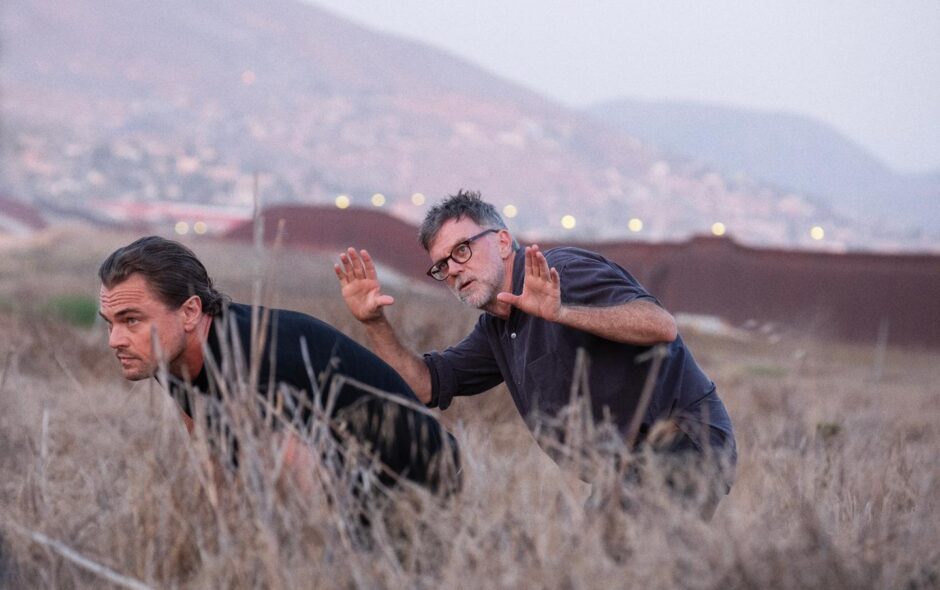
Paul Thomas Anderson’s One Battle After Another has quickly climbed to the front of the awards-season conversation, becoming one of the most talked-about films of the year. Blending political drama, dark humor, and a fraught father-daughter journey, the film marks Anderson’s return to large-canvas storytelling, and early word of mouth suggests he’s delivered one of his most ambitious works yet.
The story centers on Bob Ferguson, played by Leonardo DiCaprio, a former revolutionary who has withdrawn from society and is raising his teenage daughter, Willa, in a remote corner of Northern California. Their uneasy peace shatters when Willa disappears under mysterious circumstances, pulling Bob back into a world he has tried desperately to leave behind. To find her, he reunites with a group of former comrades whose past actions echo through the present, forcing Bob to face both the ideals that once defined him and the consequences that continue to haunt him.
Willa is portrayed by Chase Infiniti, whose performance has drawn particular attention for its emotional clarity and unforced presence. Their father-daughter dynamic forms the emotional spine of the film, grounding its political threads in something intimate and deeply human. The supporting cast includes Sean Penn, Benicio del Toro, Regina Hall, and Teyana Taylor, each adding dimension to Anderson’s vision of a fractured counterculture wrestling with its own legacy.
The film is written and directed by Anderson, who loosely shapes the narrative from themes explored in Thomas Pynchon’s Vineland while crafting something unmistakably his own. His screenplay moves between satire and tragedy with the kind of tonal agility that has defined his best work. The result is a film that feels at once expansive and personal, with a rhythm that balances Anderson’s eye for absurdity against a steady emotional undertow.
Early viewers have responded strongly to the film’s boldness. Much of the praise has centered on DiCaprio, who anchors the story with a performance that is both interior and volatile, a portrait of a man trying to reconcile who he was with who he has become. Chase Infiniti has also emerged as one of the year’s breakout performers, offering a portrayal that feels lived-in rather than manufactured, a teenager caught between fierce independence and quiet vulnerability.
Anderson’s filmmaking is equally central to the enthusiasm surrounding the movie. His visual style—long takes, sharp contrasts, and a meticulous sense of place—renders Northern California’s rugged landscapes with near-mythic force. The film’s pacing is deliberate but gripping, an accumulation of tension rather than a chase toward spectacle. Viewers have noted that Anderson trusts his audience, building momentum through character rather than conventional action beats.
What people are talking about most, though, is the film’s refusal to simplify. It examines political extremism without romanticizing it, family loyalty without turning sentimental, and the aftershocks of idealism with a clear, unsparing eye. Some early reactions describe it as a challenging film—rich, layered, and not designed for passive viewing. Even so, the overall sentiment is that One Battle After Another feels like the kind of movie that lingers long after it ends.
As awards season gains momentum, the film is already being positioned as a leading contender in major categories, particularly Best Picture, Best Director, Best Actor, and Supporting awards for both del Toro and Infiniti. The enthusiasm around it has the early electricity of a film that could shape the tone of the season.
For Anderson, One Battle After Another marks a return to the kind of large-scale, emotionally charged storytelling that first cemented his reputation. For DiCaprio, it’s one of his most focused, grounded performances in years. And for audiences, it appears to be the rare film able to combine political urgency with human depth—one battle after another, but always anchored in something real.